
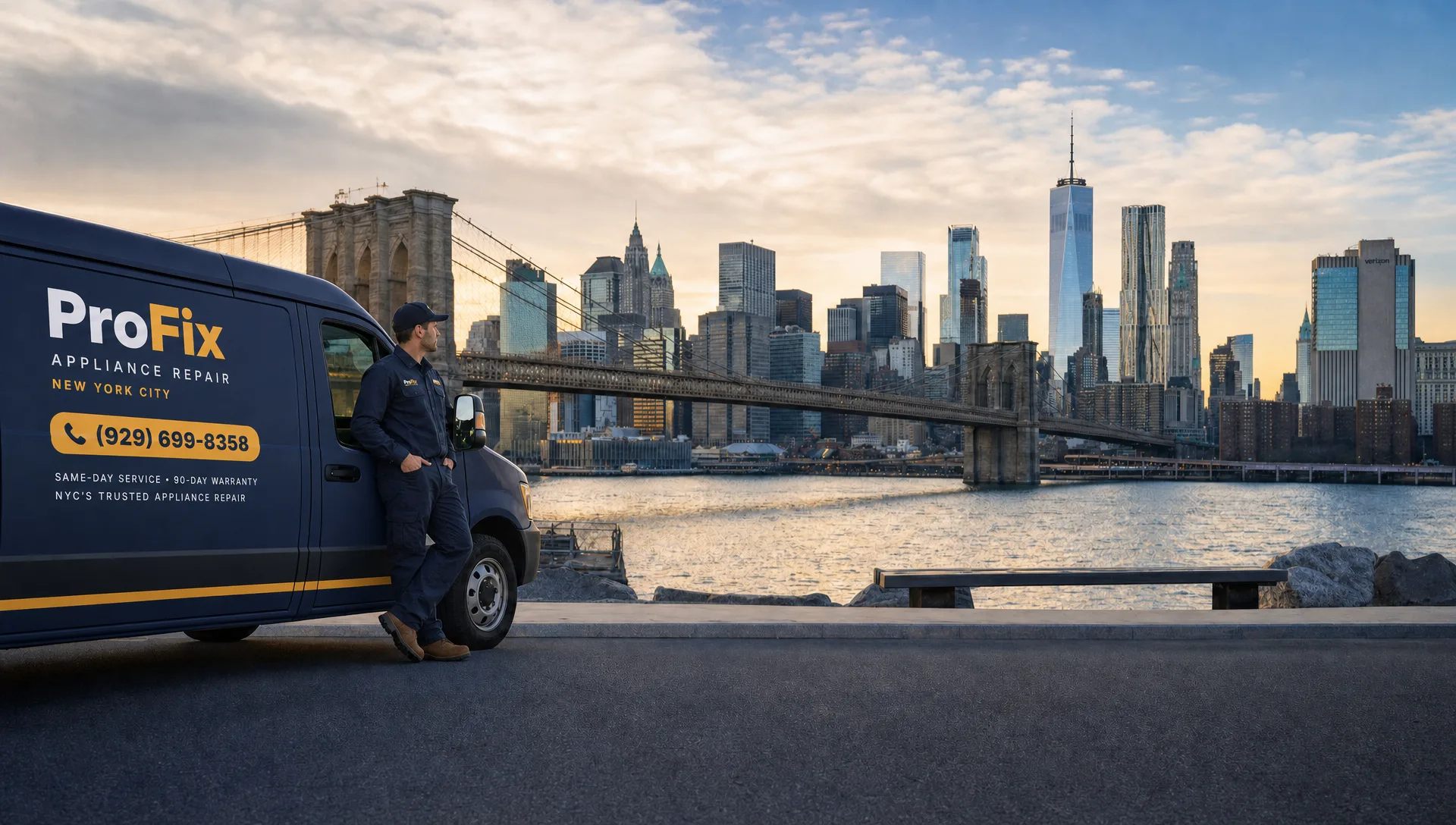
10038 Service Area
Appliance Repair Near Me in 10038, Lower Manhattan, New York City
Same-day local appliance repair near you in 10038 — proudly serving Lower Manhattan and the surrounding New York County (Manhattan) neighborhoods.
Mon–Sat 7am–8pm · Sun 9am–5pm
Schedule Your Repair
Service Type
What type of service do you need?
Or call us directly:
(929) 699-8358Requests here run from refrigerators warming up and washers stopping mid-cycle to gas ranges whose burners click without catching. Freezers, dryers, dishwashers, ovens, cooktops, microwaves, ice makers and wine coolers are covered as well, for every major brand. Restaurants and shops around the Seaport can book commercial equipment through the same number as households.
The scheduling line runs weekdays 7:00 AM to 8:00 PM, Saturdays 8:00 AM to 6:00 PM and Sundays 9:00 AM to 5:00 PM. Same-day appointments are available when the calendar allows, with a three-hour arrival window for every booking. Completed repairs carry a 90-day warranty on parts and a 30-day warranty on labor.
Few corners of Manhattan hold such a mix of eras within a short walk. A single block near the waterfront may pair a brick building from the age of sailing ships with a glass tower finished in the last decade, and the appliances inside reflect that same spread, which is why a thorough diagnosis matters more than assumptions about the building.
Brands Serviced in 10038
















































Appliances We Repair in 10038
Select an appliance for Lower Manhattan-wide repair details, or call (929) 699-8358 to book directly for 10038.
Built for New York — Apartments, Co-ops & More
ZIP 10038 stretches across the eastern side of Lower Manhattan, from the South Street Seaport and its cobblestone blocks through the eastern Financial District and up toward the Brooklyn Bridge, brushing the southern edge of Chinatown. Restored nineteenth-century buildings, large residential complexes and modern towers all share the ZIP. ProFix Appliance Repair New York takes repair calls throughout it at (929) 699-8358.
How It Works
Available Now · Brooklyn, Queens, Staten Island, and Manhattan
Ready to schedule your repair?
ProFix NYC — trusted by thousands of NYC homeowners. Same-day slots available.
Homes and Appliances in 10038
The Seaport's historic streets include low-rise brick buildings converted to apartments over shops and restaurants, many with compact kitchens and walk-up stairs. Elsewhere in the ZIP, large mid-century residential complexes house thousands of people, often organized as cooperatives with their own management offices and maintenance staff. Newer towers add luxury rentals and condos with integrated kitchens.
That variety produces a wide range of appliances: long-serving freestanding ranges and top-freezer refrigerators in established apartments, alongside panel-ready dishwashers and stacked laundry in recent construction. Older top-freezer models rely on a defrost system that, when it fails, lets frost build on the rear wall of the freezer and gradually starves the fresh-food section of cold air.
Co-op complexes may operate centralized laundry rooms run by the building, while newer towers tend to put a washer-dryer in each unit. Machines in a building-run laundry room are normally maintained through management or a laundry vendor, so tenants who rely on them should report faults there rather than booking a private repair.
Parts of 10038 sit close to the East River waterfront, and the Seaport area flooded during Hurricane Sandy in 2012, damaging ground floors and basements. Many buildings repaired or relocated mechanical equipment afterward. For residents, the practical takeaway is that basement laundry and storage spaces near the water may have been rebuilt with layouts and equipment different from what existed before.
Brooklyn Bridge traffic and the ramps around it border the northern part of the ZIP, and buildings near those approaches can experience heavy congestion at peak hours. That is mainly a timing consideration for visitors rather than anything specific to appliances, but it helps to know when choosing between a morning and an afternoon slot.
Repair vs. Replacement in 10038
Whether repair or replacement makes sense in 10038 depends heavily on the building. In a walk-up above a Seaport storefront, getting a new refrigerator up a narrow staircase can be a genuine struggle, so restoring the existing unit is often the easier path. In an elevator building replacement is logistically simpler, though still subject to delivery rules.
Older appliances in established co-op apartments can be good candidates for repair when the problem is one worn part, such as a gasket, thermostat, timer, defrost component or igniter. If the machine shows several serious failures at once, the technician will say so, along with what parts remain available, so you can make a sensible choice for your household.
Co-op shareholders usually own the appliances in their apartments and can book directly, while renters should check with their landlord first. Complexes with an on-site maintenance office may have rules about outside contractors, so a quick call to that office before the visit can prevent a wasted trip and a rescheduled appointment.
Shops and restaurants along the Seaport's historic streets often run refrigeration and cooking equipment hard during busy seasons. For a business, a repair that can be finished quickly may be worth more than a replacement that takes days to arrange and install through a narrow storefront. The technician can explain the timing for parts so you can plan around service hours.
What to Expect From a Service Call in 10038
Call with the appliance type, brand and symptoms. If your complex requires contractors to register with the management office or provide an insurance certificate, say so during booking. For walk-up buildings near the Seaport, mention how many flights the technician will climb, since that helps in planning what tools and parts to carry up in one trip.
Some Seaport streets are narrow and pedestrian-heavy, and parking near the waterfront can be limited, which the three-hour arrival window allows for. Make sure someone can let the technician into the building, whether through a doorman, an intercom or a management office, and clear the area around the appliance before the window opens.
The technician confirms the problem, walks you through the diagnosis and describes the fix before starting. If the right part is on hand, the repair can often be completed at once; otherwise a second appointment is arranged once the part arrives. The appliance is tested before the visit ends, and the warranty covers parts for 90 days and labor for 30 days.
If your apartment has been renovated with newer appliances while the building itself is much older, mention it when you book. The technician then knows to expect modern controls and connections inside an older shell, which can affect how the appliance is reached, how water and gas lines are routed and what parts may be needed.
10038 Local Statistics
These are general facts about ZIP 10038 and our service terms, not statistics from company job records.
Still have questions?
Our NYC team is ready — same-day service across Brooklyn, Queens, Staten Island, and Manhattan.